

What Is a CPA Certified Public Accountant? Full Definition and Role Explained for South Carolina Businesses
Simplify your finances; focus on growth

Introduction: Why Understanding This Title Matters
As a South Carolina business owner, you see the acronym “CPA” everywhere. You know they are respected, and you know they are expensive. But do you truly know what a Certified Public Accountant does?
Whether you are just starting your LLC in Columbia or scaling a business in Charleston, understanding the role of a CPA is crucial. Many business owners make the mistake of hiring a CPA for tasks that don’t require one, overpaying thousands of dollars a year.
In this guide, we will break down the full definition of a CPA, their legal authority, and help you decide when you actually need one — and when a professional tax preparer or bookkeeper is the smarter choice.
- Certified QuickBooks & Wave Expert
- Individual & S-Corp Tax Preparation
- 1099 Preparation & Tax Compliance
- Trusted by Small Businesses & Entrepreneurs

What Is a CPA? (The Full Definition)
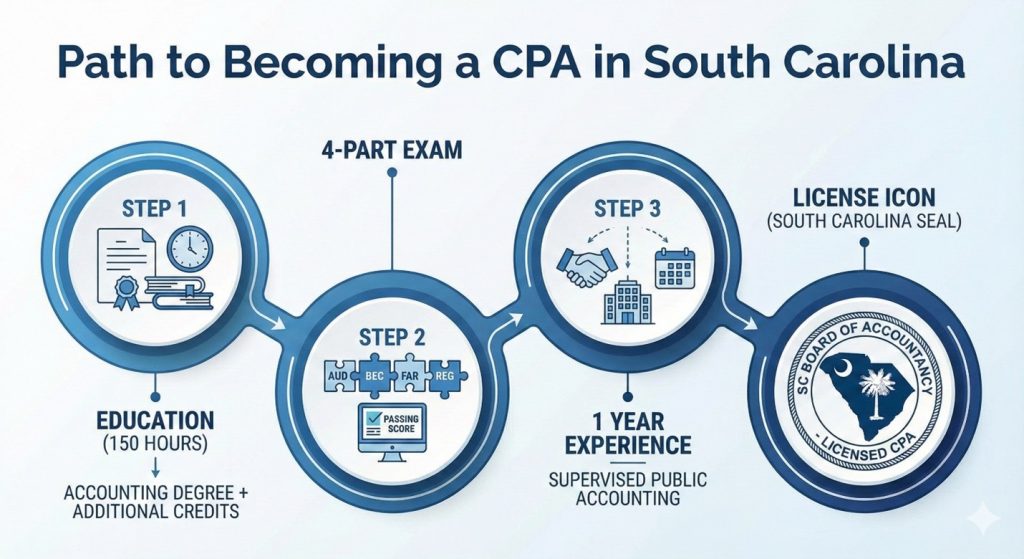
A. Certified Public Accountant Explained
A CPA is a state-licensed accounting professional who has passed the rigorous Uniform CPA Examination and met strict state education and experience requirements.
Unlike a standard accountant, a CPA is legally authorized by the government to:
- Perform official audits (Attestation).
- Represent clients before the IRS (Unlimited Representation Rights).
- Provide high-level tax strategy and financial planning.
They are the highest standard in accounting — the only professionals who can sign audited financial statements.
B. The "Three E's of Licensing (South Carolina Standards)
Becoming a CPA in South Carolina is incredibly difficult. It requires:
- Education: A Bachelor’s Degree plus 150 semester hours of advanced coursework (Master’s Level).
- Exam: Passing a grueling 4-part exam that covers Law, Auditing, Taxation, and Financial Reporting (Pass rate is only ~50%).
- Experience: At least one year of work under the direct supervision of a licensed CPA.
- Continuing Education: Completing 40 hours of CPE every year to stay updated on tax laws.
What Does a CPA Do? (Key Responsibilities)
A CPA wears many hats, but their core legal responsibilities fall into four buckets:
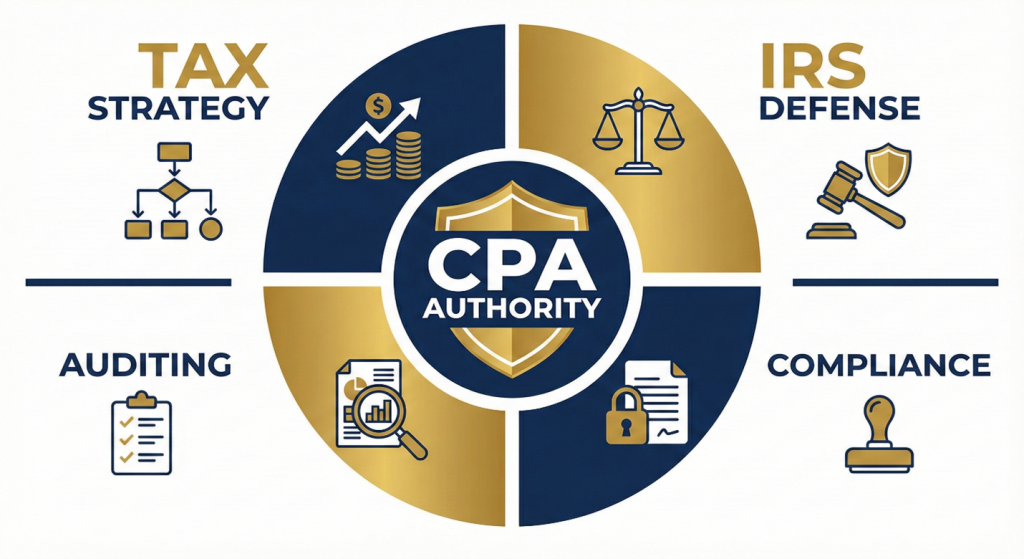
1. IRS Representation
This is their primary superpower. If your business gets audited, a CPA can legally stand in for you in tax court, negotiate with the IRS agent, and handle the entire defense process.
2. Audit Services (Attestation)
If you need a bank loan over $1 Million, the bank will often demand “Audited Financials.” Only a CPA can sign these reports, certifying that your numbers are accurate.
3. Complex Tax Strategy
CPAs handle complex scenarios like mergers, acquisitions, international tax treaties, and estate planning.
4. Fiduciary Duty
CPAs have a legal “Fiduciary Duty” to the public. This means they are bound by a strict code of ethics to be transparent and honest, or they risk losing their license.
CPA vs. Bookkeeper vs. Accountant: What’s the Difference?
To manage your money wisely, you need to know who does what.
|
Professional |
Primary Function |
Analogy |
|
Bookkeeper |
Daily recording, Payroll, Reconciliation |
The Builder (Lays the bricks daily) |
|
Tax Preparer |
Prepares & files tax returns |
The Inspector (Checks compliance) |
|
CPA |
Audits, IRS Defense, Complex Strategy |
The Architect (Designs & certifies) |
The Reality Check:
You wouldn’t pay an Architect $300/hour to lay bricks. Similarly, you shouldn’t pay a CPA to categorize your daily receipts.
When Do You Actually Need a CPA?
Hire a CPA When:
- You are facing an Audit: You need legal defense.
- You are raising capital: Investors require audited statements.
- You have complex legal structures: Trusts, C-Corps, or International sales.
You Do NOT Need a CPA For:
- Monthly Bookkeeping: Use a professional bookkeeper.
- Running Payroll: Use a payroll specialist.
- Standard Tax Filing: An experienced Tax Preparer or Enrolled Agent is often more affordable and equally capable for standard S-Corps and LLCs.
The Smart Strategy: Don't Overpay for the Title
Many business owners burn money by sending unorganized records to a CPA. The CPA then charges their high hourly rate just to clean up the mess before they can do any strategy.
The Best Approach for Small Businesses:
- Hire a Professional Bookkeeping Service (Like JM Elitebooks): We handle the daily grind — recording transactions, reconciling banks, and running payroll — at an affordable rate.
- Keep Your Books “CPA-Ready”: We ensure your financial reports are 100% accurate and organized.
- Consult a CPA Only When Needed: If you ever face a complex legal issue or audit, you can take our clean reports to a CPA. Since the work is already done, they will spend less time (and charge you less money) to review it.

Conclusion
A CPA is a powerful asset for specific high-level needs like audits and litigation. However, for the day-to-day health of your business, reliable bookkeeping and accurate tax preparation are what matter most.
Don’t pay surgeon rates for a check-up.
Ensure your books are accurate first. If you need help organizing your finances so you are always tax-ready, JM Elitebooks is here to help.
Need help getting your books in order?
Schedule a free consultation to see how we keep your business financially healthy year-round.