
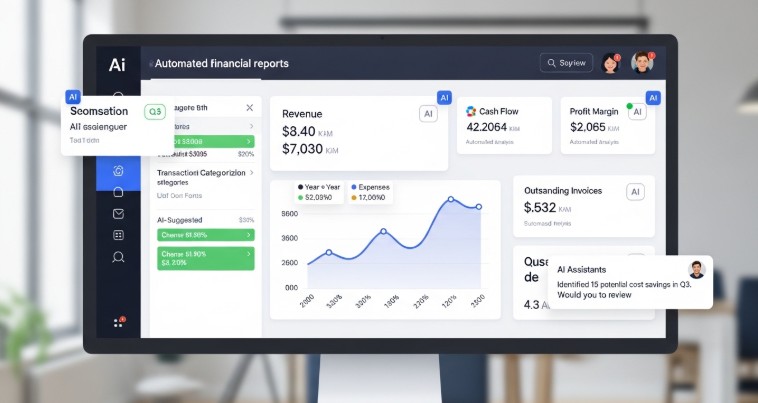
Managing finances manually is no longer sustainable for most modern businesses. From missed entries to delayed reporting, traditional bookkeeping often creates more problems than it solves. This is exactly where AI-powered bookkeeping changes the game.
Today, businesses are actively searching for how to use AI for bookkeeping to reduce workload, improve accuracy, and automate repetitive financial tasks. Whether you’re a freelancer, small business owner, or accounting professional, AI can significantly streamline your financial operations.
This guide breaks everything down into practical steps, real-world applications, and expert insights so you can confidently implement AI into your bookkeeping workflow.
Short Answer: How to Use AI for Bookkeeping?
AI for bookkeeping works by automatically categorizing transactions, reconciling accounts, and generating financial reports using machine learning tools.
You connect your bank accounts, accounting software, or spreadsheets to an AI system. The system then learns your financial behavior and begins organizing data with minimal manual input.
Best use case includes small businesses, freelancers, and accounting teams handling repetitive bookkeeping tasks.
Key takeaway: AI reduces human error, saves time, and improves financial accuracy by automating core bookkeeping functions.
What Is AI Bookkeeping and How It Works
AI bookkeeping refers to the use of machine learning algorithms and automation tools to manage financial records without constant manual intervention.
Unlike traditional bookkeeping, which relies heavily on human input, AI systems analyze patterns in financial data and automate classification, reconciliation, and reporting.
Modern AI bookkeeping tools integrate with cloud accounting software, bank feeds, and invoicing platforms. They continuously learn from transactions to improve accuracy over time.
This transformation is reshaping financial management by making it faster, more scalable, and significantly more reliable for businesses of all sizes.
Common Problems AI Solves in Bookkeeping
AI is specifically designed to eliminate repetitive and error-prone financial tasks, including:
- Manual data entry errors that lead to inaccurate reports
- Slow and time-consuming bank reconciliation processes
- Missing or miscategorized expenses and income entries
- Delayed financial reporting that affects decision-making
- Poor visibility into cash flow for small businesses
These issues are common in traditional systems but become nearly eliminated when AI automation is properly implemented.
How to Use AI for Bookkeeping Step-by-Step Guide
How to Use AI for Bookkeeping in Small Businesses
Implementing AI bookkeeping is straightforward if done systematically:
Step 1: Choose AI bookkeeping software
Select a platform that integrates with your bank and accounting system.
Step 2: Connect bank accounts and financial tools
Link your business accounts, payment processors, and invoicing tools.
Step 3: Train AI with past financial data
Upload historical transactions so the system can learn categorization patterns.
Step 4: Automate transaction categorization
Allow AI to sort income and expenses into predefined categories.
Step 5: Enable invoice and expense tracking automation
Turn on smart receipt scanning and invoice matching.
Step 6: Generate AI-powered financial reports
Create balance sheets, cash flow statements, and profit summaries automatically.
Step 7: Review and approve AI suggestions
Regularly verify outputs to ensure accuracy and compliance.
Time required: 1–3 hours setup
Difficulty: Easy to moderate
Best AI Features Used in Bookkeeping Systems
Modern AI bookkeeping platforms include powerful automation features such as:
- Automated transaction classification
- Smart invoice recognition and data extraction
- Expense forecasting and budgeting tools
- Real-time financial dashboards for business visibility
- Fraud detection alerts for unusual transactions
- Tax preparation assistance and deduction tracking
These features significantly reduce manual effort while improving financial accuracy.
Comparison Table: AI Bookkeeping vs Traditional Bookkeeping
| Method | Accuracy | Time Required | Cost | Best For |
|---|---|---|---|---|
| Manual bookkeeping | Medium | High | Low | Small startups |
| Spreadsheet tracking | Low–Medium | High | Low | Freelancers |
| AI bookkeeping tools | High | Low | Medium | Growing businesses |
| Accountant-only system | High | Medium | High | Large enterprises |
DIY vs Professional Bookkeeping with AI Tools
Can You Use AI for Bookkeeping Yourself?
Yes. Modern AI tools are designed for non-accountants as well.
They require only basic knowledge of financial categories and business transactions. Most platforms offer dashboards, automation setups, and guided workflows.
This makes them ideal for freelancers and small business owners looking to reduce bookkeeping costs while maintaining accuracy.
When to Hire a Professional Accountant
Despite automation, professional support is still necessary in certain cases:
- Complex tax structures and multi-state compliance
- Large-scale business financial operations
- Audit preparation and legal reporting requirements
- Multiple revenue streams requiring advanced classification
- Situations where compliance accuracy is critical
AI supports accounting, but it does not fully replace expert financial judgment.
Common Challenges When Using AI for Bookkeeping
Even with automation, businesses may face challenges such as:
- Incorrect transaction categorization in early stages
- Limited customization in entry-level AI tools
- Dependency on clean and structured financial data
- Learning curve for first-time users
- Integration issues with older accounting systems
These issues typically reduce as the system learns and improves over time.
Cost of Using AI for Bookkeeping
AI bookkeeping pricing varies based on features and business size:
- Basic AI tools: $10–$30/month
- Mid-level accounting AI systems: $30–$100/month
- Advanced enterprise solutions: $100–$500+/month
- Optional setup or migration services may incur one-time fees
Overall cost depends on automation level and operational complexity.
Safety and Accuracy Considerations
When using AI for financial management, accuracy and security are critical:
- Always verify AI-generated financial reports
- Maintain backups of raw financial data
- Use platforms with strong encryption and security protocols
- Conduct regular audits to avoid categorization errors
- Avoid relying entirely on AI for tax filing without human review
How to Improve Results When Using AI for Bookkeeping
To maximize AI performance:
- Feed clean and structured financial data consistently
- Train AI with updated transaction records regularly
- Use integrated accounting ecosystems instead of standalone tools
- Combine AI automation with periodic human review
- Automate repetitive tasks, but supervise complex decisions
FAQs About How to Use AI for Bookkeeping
How does AI help in bookkeeping?
AI automates data entry, categorization, reconciliation, and financial reporting.
Is AI bookkeeping accurate?
Yes, accuracy improves significantly with clean data and continuous use.
Can small businesses use AI for bookkeeping?
Yes, it is highly beneficial for small and medium-sized businesses.
Do I still need an accountant if I use AI?
Yes, for compliance, tax strategy, and financial auditing.
Is AI bookkeeping expensive?
No, most tools are affordable and subscription-based.
Can AI replace human bookkeepers completely?
Not fully, but it significantly reduces manual workload.
What is the best AI tool for bookkeeping?
It depends on business size, integration needs, and budget.
Is AI bookkeeping safe for financial data?
Yes, if secure and encrypted platforms are used.
Conclusion: Is AI the Future of Bookkeeping?
AI is fundamentally transforming bookkeeping into a faster, smarter, and more efficient system. Businesses adopting automation are already experiencing fewer errors, better financial visibility, and improved decision-making. JM Elite Books is also an example of how modern bookkeeping approaches are evolving with smarter systems and structured financial management practices that align with automation-driven workflows.
However, the most effective approach is not full replacement but intelligent collaboration between AI and human expertise.
Companies that embrace AI bookkeeping early gain a clear competitive advantage through automation, accuracy, and operational efficiency.
The future of bookkeeping is not manual, it is intelligent, automated, and data-driven.