
The way you pay yourself out of your business is one of the most scrutinized areas of small business taxation. Owners who get it wrong end up with reclassified income, back payroll taxes, penalties, and in worst cases, full audits. Owners who get it right keep more money, stay compliant, and build clean financial records that hold up under any review.
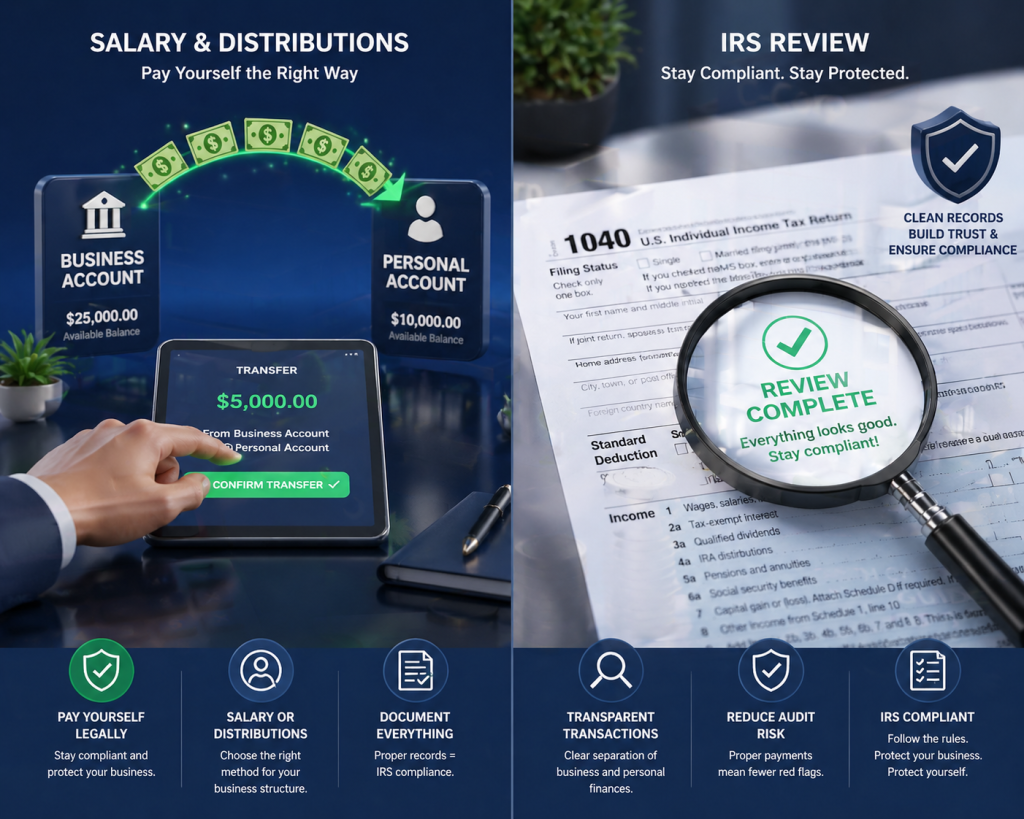
The rules differ sharply between an LLC and an S-Corp. A default LLC owner takes draws. An S-Corp owner has to take a W-2 salary first, then can take distributions. Mixing those two up, or treating them casually, is exactly what gets the IRS interested in your return.
Here is how the mechanics actually work, what counts as a defensible payment method for each structure, and the specific habits that separate audit-proof owners from the ones who get a letter from the IRS.
How LLC Owners Pay Themselves: The Owner’s Draw
A single-member LLC or multi-member LLC taxed as a partnership uses owner draws. There is no payroll. There are no W-2s for the owner. Money simply moves from the business bank account to the owner’s personal account, and that transfer is recorded as an equity reduction, not as an expense.
The mechanics:
- Write yourself a check or set up a recurring transfer
- Record the transaction as an Owner’s Draw against owner’s equity
- Do not run it through payroll software
- Do not include it in payroll tax filings
Taxes are paid through quarterly estimated payments based on net business profit, not on what you actually withdraw. Even if you leave $100,000 in the business account and only draw $20,000, you still owe income tax and self-employment tax on the full $100,000.
This is where many new LLC owners panic. They draw heavily early in the year, then realize at tax time they owe taxes on profit they have already spent. Building quarterly estimated payments into the routine, calculated against actual profit and not against draws, prevents that surprise.
The Owner’s Draw vs. Owner’s Salary Trap
A common mistake is treating an LLC owner’s draw like a salary. Owners create a recurring paycheck through Gusto or QuickBooks Payroll, withhold federal taxes, issue themselves a W-2, and report wage expense on the books. This is wrong for a default LLC and creates a serious problem at year end.
The IRS does not allow an LLC member to be treated as a W-2 employee of their own business unless that LLC has elected S-Corp or C-Corp tax treatment. If you ran payroll on yourself as a default LLC owner all year, the wage expense gets disallowed, the FICA taxes paid get refunded with paperwork, and your books need a full cleanup.
Setting up bookkeeping correctly from day one prevents these tangles. If your books already mix draws, wages, and personal expenses, a QuickBooks cleanup before year-end can untangle the accounts and reclassify entries before your tax preparer sees them.
How S-Corp Owners Pay Themselves: Salary Plus Distributions
The S-Corp election triggers an entirely different system. The IRS requires S-Corp shareholder-employees who provide services to the company to take reasonable compensation as a W-2 salary before taking any distributions.
The structure:
- Set up payroll for yourself through Gusto, ADP, QuickBooks Payroll, or similar
- Run regular payroll: withhold federal income tax, FICA, Medicare, and state tax
- Issue yourself a W-2 at year end
- Take additional profit as shareholder distributions, recorded as equity reductions, not wages
This split is where the tax savings come from, and it is also where audits start. The IRS knows that S-Corp owners are tempted to keep their salary low (saving on payroll taxes) and take huge distributions (which skip self-employment tax). They have built specific audit selection criteria around this exact behavior.
Running payroll for yourself adds real costs to the business, including software fees, accountant fees, and the time spent on quarterly filings. Before electing S-Corp status, look at what accountants typically charge for payroll services so the savings net out positive after all the new compliance costs are factored in.
What Reasonable Compensation Actually Means
The IRS does not publish a fixed dollar amount or formula for reasonable compensation. The standard is: what would you have to pay someone with similar skills, experience, and time commitment to do the same job in your geographic market?
Three accepted methods for documenting reasonable compensation:
The Cost Approach
Calculate the salary based on the cost of replacing each function the owner performs. If the owner spends 20% of time on sales (worth $80,000 a year), 30% on operations ($75,000), and 50% on technical work ($90,000), the blended salary works out to a documented figure with backup.
The Market Approach
Pull data from sources like the Bureau of Labor Statistics, Glassdoor, Indeed, RCReports, or Salary.com for the owner’s role and region. Document the source, date, and methodology used.
The Income Approach
Calculate based on what an outside investor would expect the company to retain after paying the owner a market-rate salary. Less common, more complex, but defensible when supported by industry profitability data.
Whichever method you use, document it before payroll starts, not after the IRS comes knocking. Save the screenshots, the calculations, and the source data in a folder. If the IRS questions your salary, that documentation is the difference between a quick close and a full reconstruction of your wages going back years.
The 60/40 Rule Myth
Search for S-Corp salary advice and you will find the 60/40 rule recommended on dozens of sites: pay yourself 60% as salary and take 40% as distributions. There is no such IRS rule. It does not exist in the tax code, regulations, or any official guidance.
The 60/40 split has no legal weight. Some accountants use it as a rough rule of thumb, but it does nothing to defend a salary that is unreasonable for the work performed. A consultant making $400,000 a year with a $240,000 salary (60%) might still be flagged if the comparable market rate for that work is $150,000. Conversely, a service business owner making $80,000 with a $32,000 salary (40%) might be perfectly defensible if the market rate for that role is $30,000 to $35,000.
Reasonable compensation is built on the work performed, not on a percentage of profit.
Audit Triggers Specific to S-Corp Owner Compensation
The IRS uses several signals to flag S-Corps for closer review:
Zero or near-zero W-2 wages combined with substantial distributions. This is the biggest red flag. An S-Corp showing $300,000 in profit, $0 in officer wages, and $300,000 in distributions is almost guaranteed to receive scrutiny.
Officer compensation that is far below industry medians. The IRS pulls data on similar businesses by NAICS industry code and flags outliers.
Distributions taken before salary is paid. The salary should be paid through regular payroll cycles, not as a year-end true-up. If distributions hit the owner’s bank account in March but no payroll runs until December, the timing pattern itself is suspicious.
Loans to shareholders that never get repaid. Some owners try to disguise distributions as loans. Without a written note, market interest rate, and repayment schedule, the IRS will recharacterize loans as wages.
Sloppy bookkeeping that mixes personal and business expenses. When books show personal car payments, groceries, and vacation charges paid out of the business account, the IRS treats those as constructive distributions, often pulling more transactions into review. Clean financial accounting that separates owner activity properly is the single biggest defense against this kind of expansion.
How to Take Distributions Properly
Once the salary is in place, distributions are straightforward but still require discipline:
Move money from the business account to the owner’s account on a clear schedule. Avoid round-tripping money in and out of the business multiple times a month, which makes books harder to audit cleanly.
Record each transfer as a distribution against shareholder equity, not as an expense. Distribution accounts on the balance sheet should track each owner separately for multi-owner S-Corps.
Make sure distributions match ownership percentages. S-Corps cannot have unequal distributions among shareholders. If two owners each hold 50%, every distribution must split 50/50, even if one owner takes their share later. Unequal distributions can cause the IRS to terminate the S-Corp election entirely, which is catastrophic.
Pay distributions only when the company has retained earnings to support them. Distributions exceeding the shareholder’s stock basis become taxable capital gains, and tracking basis is one of the more confused areas of S-Corp accounting.
The Health Insurance and Retirement Quirk for S-Corp Owners
S-Corp owners with more than 2% ownership have unique rules around health insurance and retirement contributions:
Health insurance premiums paid by the S-Corp on the owner’s behalf must be added to W-2 wages in Box 1, but not Box 3 or 5 (no FICA tax). The owner then deducts the premium amount as a self-employed health insurance deduction on the personal return. Skip this step and the deduction is lost.
Retirement contributions must be calculated based on W-2 wages, not on distributions. An S-Corp owner with $40,000 in salary and $200,000 in distributions can only base SEP-IRA or Solo 401(k) contributions on the $40,000 salary figure. Owners aiming for maximum retirement contributions sometimes raise their salary specifically to support a larger contribution.
These details get missed when payroll is set up by software defaults. A year-end W-2 review with an accountant who handles S-Corp compensation regularly catches the errors before they hit the personal return.
Documentation Habits That Keep Owners Out of Trouble
Owners who survive audits without adjustments share a common set of habits:
- They run payroll on a consistent schedule. Monthly or biweekly, every month, even if it means a smaller per-period amount.
- They document the reasonable compensation calculation in writing before the year starts and review it annually as the business changes.
- They keep distributions in a separate account or clearly labeled in QuickBooks, not lumped with operating expenses.
- They never run personal expenses through the business account. Every meal, every Amazon order, every gas station charge has to be sorted at month-end if it does flow through, and the cleaner approach is to use a personal card from the start.
- They reconcile bank and credit card accounts every month, so the year-end balance sheet reflects actual activity, not catch-up estimates.
For owners running multi-entity setups or higher-revenue operations, handing off the bookkeeping and payroll setup to a specialist removes the audit risk altogether. A complete business accounting and tax preparation engagement ties the books, payroll, and entity returns together so nothing slips through the cracks.
A Simple Year-End Checklist
Before the December 31 cutoff, every LLC and S-Corp owner should:
- Confirm the salary paid through payroll matches the documented reasonable compensation analysis
- Verify all distributions are recorded against equity, not as expenses
- Reconcile every bank and credit card account through year-end
- For S-Corps, add health insurance premiums to W-2 Box 1 before final payroll runs
- Check that retirement plan contributions are based on W-2 wages, not total profit
- Print and save the documentation supporting the salary calculation
A 30-minute review in early December is far cheaper than a full audit reconstruction in the spring.
The way owners pay themselves is rarely glamorous and rarely the topic of dinner conversation. But few decisions affect after-tax wealth more directly. Get the structure right, document the reasoning, and run the books cleanly, and the IRS has no grounds to come after the savings. Skip those steps, and the savings disappear into back taxes and penalties faster than anyone expects.
If you are setting up payroll for the first time or revisiting an S-Corp salary that has not been reviewed in years, working with someone who connects the business return to your personal tax preparation makes sure both sides line up cleanly and that the salary, distributions, and W-2 numbers all reconcile back to a single, defensible plan.