
The home office deduction has a reputation for triggering audits, but most of that fear is outdated. The IRS introduced the simplified method in 2013 specifically to make this deduction easier to claim and easier to defend. Used correctly, it can put up to $1,500 a year back in a small business owner’s pocket through the simplified route, and significantly more through the actual expense method.
Beyond the dollar value, the deduction also reduces self-employment tax for sole proprietors and single-member LLC owners, which means the real after-tax savings stack higher than the headline number. The catch is that the eligibility rules are strict, and self-employed owners who skip the documentation routinely lose the deduction during exam.
This is the full 2026 framework. Who qualifies, how each method calculates the deduction, what records to keep, the depreciation recapture trap most owners miss, and how to avoid the specific patterns that get returns flagged for review.
Who Qualifies for the Home Office Deduction
The Tax Cuts and Jobs Act eliminated the home office deduction for W-2 employees through 2025, and that change is set to expire after 2025. As of 2026, the deduction is available primarily to:
- Self-employed individuals filing Schedule C
- Single-member LLC owners taxed as a sole proprietorship
- Partners reporting unreimbursed partnership expenses on Schedule E
- S-Corp owners through accountable plan reimbursements (covered later)
W-2 employees still cannot deduct home office expenses on a federal return as of the 2025 tax year, even when they work from home full-time. If Congress restores the miscellaneous itemized deduction after the TCJA sunsets, that may change. Until then, the deduction belongs to business owners.
To qualify, the home office must pass two tests:
The Regular and Exclusive Use Test
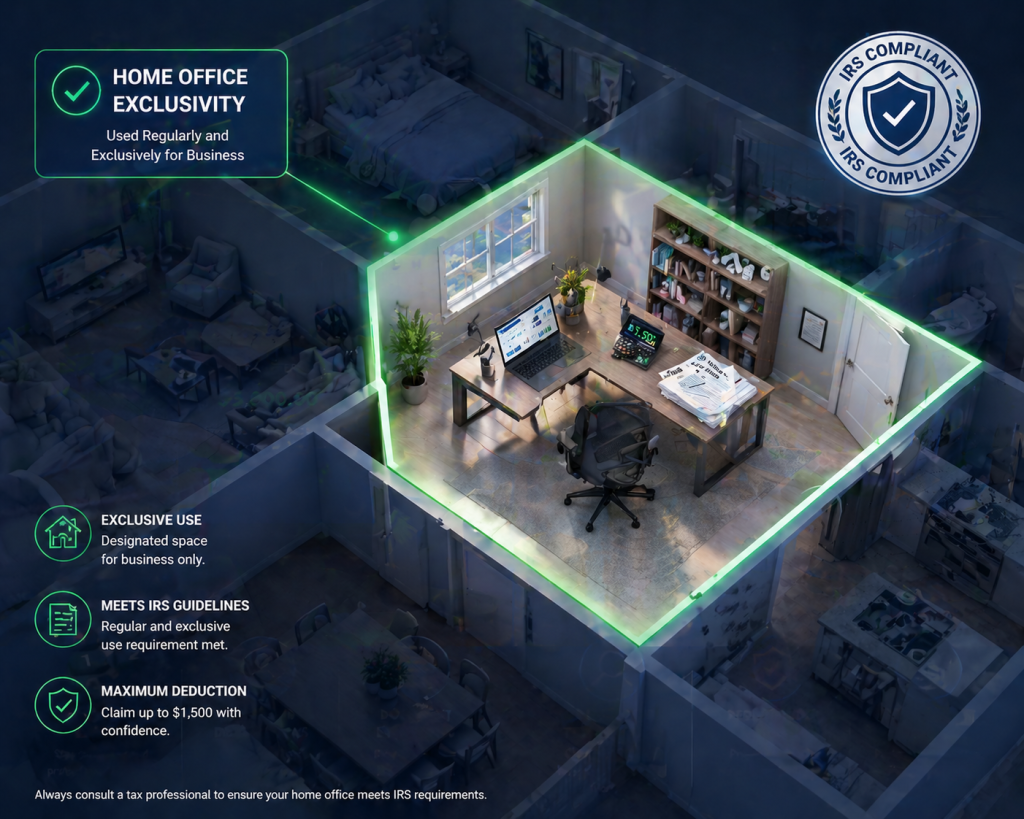
The space must be used regularly for business and exclusively for business. A guest bedroom that doubles as an office for half the day fails this test. A dedicated room or clearly partitioned area used only for the business passes.
The Principal Place of Business Test
The home office must be the principal place where you conduct business, or it must be a place where you regularly meet clients, or it must be a separate structure (such as a detached garage or studio) used only for business.
A photographer who shoots at client locations but does all editing, billing, and admin work from a dedicated home office passes the principal place test because that is where the management and administrative work happens.
A consultant who occasionally takes calls at the kitchen table fails because no specific area is exclusively dedicated to business use.
Get the qualification piece wrong and the deduction collapses regardless of how clean the math is. Most disallowed home office deductions during audits trace back to space that was not truly exclusive.
The Simplified Method: $5 Per Square Foot, Up to $1,500
The simplified method does exactly what the name suggests. Calculate the square footage of the home office, multiply by $5, cap at 300 square feet ($1,500 maximum), and report the result on Schedule C.
Example: A home office measures 12 feet by 14 feet, or 168 square feet. The simplified deduction is $5 multiplied by 168, equaling $840.
What makes this method appealing is what it eliminates:
- No tracking of utility bills, mortgage interest, insurance, or repairs
- No proportional allocation across the entire home
- No depreciation calculation
- No depreciation recapture when the home is sold (the key advantage)
- Form 8829 is not required
The trade-off is the cap. Owners with larger offices or higher actual expenses leave money on the table by choosing the simplified route. Anyone with a substantial mortgage, high utilities, or significant home maintenance costs should run the actual expense method before defaulting to the $5 calculation.
The simplified method can be selected one year and the actual method the next, or vice versa. The choice is annual, not permanent.
The Actual Expense Method: Proportional Share of Real Costs
The actual expense method works on a percentage basis. Calculate the home office’s share of the total home (typically by square footage), then apply that percentage to qualifying home expenses.
Example: A home office occupies 200 sq ft of a 2,000 sq ft home, or 10% of the total. Annual qualifying expenses include $4,000 in mortgage interest, $1,800 in property taxes, $2,400 in utilities, $1,200 in homeowners insurance, $600 in repairs, and $8,000 in calculated depreciation. The total qualifying expense is $18,000. The home office share is 10%, so the deduction is $1,800.
Expenses split into three categories:
Direct Expenses
Costs that apply only to the home office, such as painting the office or installing dedicated lighting. These are 100% deductible.
Indirect Expenses
Costs that benefit the entire home (utilities, mortgage interest, insurance, general repairs). Deducted at the home office percentage.
Unrelated Expenses
Costs that have nothing to do with the office (lawn care, landscaping for the front yard, repairs to a part of the home outside the business space). Not deductible at all.
Indirect expenses commonly include:
- Mortgage interest
- Property taxes (subject to the SALT cap interaction below)
- Homeowners insurance
- Rent (if renting instead of owning)
- Utilities: electric, gas, water, sewer, trash
- Internet (often allocated separately based on business use percentage)
- General home repairs and maintenance
- Depreciation on the home (covered below)
The actual method is reported on Form 8829 and attached to Schedule C. Each line on Form 8829 must tie back to documentation, which is why most owners using this method keep a dedicated folder of utility bills, insurance statements, and repair receipts. Allocating these expenses cleanly each month is much easier when the books are reconciled monthly. Owners who let utility bills pile up end up reconstructing months of data at year-end, which is exactly the kind of cleanup that monthly account reconciliation services are designed to prevent.
Owners who switch from the simplified method to the actual method (or vice versa) should keep records for both calculations during the transition year, because the supporting documentation requirements differ significantly.
Side-by-Side Comparison: Which Method Wins
For most small home offices, the simplified method is fine. For larger offices or homes with substantial costs, actual expenses can produce dramatically larger deductions:
Small Home Office
150 sq ft, $1,800 in qualifying home expenses prorated. Simplified deduction is $750. Actual deduction is roughly $180. Simplified wins by $570.
Medium Home Office
250 sq ft, in a $400,000 home with mortgage and utilities. Simplified deduction is $1,250. Actual deduction is roughly between $2,500 and $3,500 depending on expenses. Actual wins.
Large Home Office
400 sq ft, capped at 300 sq ft for the simplified method. Simplified deduction is $1,500. Actual deduction is typically between $4,000 and $6,000. Actual wins decisively.
The break-even point usually lands around 250 sq ft when the home has a mortgage. Below that, the simplified method’s cleaner record-keeping often outweighs the dollar difference. Above that, the actual method’s deduction grows quickly, and the documentation effort becomes worthwhile.
The S-Corp Owner Workaround: Accountable Plan Reimbursements
S-Corp owners cannot claim the home office deduction directly on the personal return because they are W-2 employees of their own business. Instead, the S-Corp can reimburse the owner for home office expenses through an accountable plan.
The mechanics:
- Set up a written accountable plan policy (a one-page document signed and dated)
- Calculate the home office percentage and applicable expenses each month
- Submit a written reimbursement request to the S-Corp with supporting documentation
- The S-Corp issues a reimbursement check from the business account
- The reimbursement is deductible to the S-Corp and tax-free to the owner
This produces the same economic result as the home office deduction, but it flows through the business return instead of the personal return. The reimbursement is not added to W-2 wages and is not subject to payroll tax.
The accountable plan must meet three IRS requirements: business connection (the expense must relate to S-Corp business), substantiation (the owner must provide documentation), and return of excess (any over-reimbursement must be returned). Setting up the categories correctly inside the bookkeeping system from day one keeps the reimbursements clean and audit-ready. Setting up QuickBooks correctly for a new business covers exactly how to set up the accounts that make accountable plan reimbursements straightforward.
The Depreciation Recapture Trap
The actual expense method requires claiming depreciation on the home office portion of the home. The depreciation deduction reduces taxable income each year, but it also reduces the home’s tax basis. When the home is eventually sold, the depreciation claimed gets recaptured and taxed at up to 25%, even if the home sale otherwise qualifies for the Section 121 capital gains exclusion.
Example: An owner claims $1,000 a year in depreciation on the home office portion for 10 years, totaling $10,000. When the home sells for a $300,000 gain (well within the $500,000 married-filing-jointly exclusion), the $10,000 in depreciation still gets taxed at 25%, costing $2,500 in additional federal tax.
This is the single biggest reason many owners stay with the simplified method even when actual expenses would produce a larger annual deduction. The simplified method has no depreciation component, so there is nothing to recapture later.
For owners planning to sell within 5 to 10 years, the depreciation recapture can wipe out a substantial portion of the actual method’s annual benefit. Run the math both ways before defaulting to whichever method seems easier.
Audit Triggers Specific to Home Office Deductions
The IRS does not single out home office returns for automatic audit, but specific patterns raise the likelihood of review:
A home office percentage above 30% of the home’s total square footage. Anything above this looks unrealistic and invites scrutiny.
Schedule C business losses that persist for multiple years while a home office deduction is claimed. The IRS will question whether the business is actually a hobby, which would disallow the home office along with other deductions.
Indirect expenses that do not match the home office percentage. If the office is 10% of the home but utility deductions equal 50% of total utilities, the math will not hold.
Depreciation calculations with no supporting basis schedule. If Form 8829 shows depreciation but no original cost basis, improvements, and adjusted basis are documented, the deduction falls apart on first review.
Switching between methods without consistent records. The IRS treats inconsistent positions across years as a flag, especially when the switches conveniently produce larger deductions in years with higher expenses.
Clean records and consistent treatment year over year is the single best defense against any of these patterns becoming a real problem.
Documentation That Holds Up Under Review
For both methods, owners should maintain:
- A dated photo or floor plan showing the dedicated office space with measurements. Take this once when the office is set up, and again if the space changes
- A square footage calculation for both the office and the total home. This number rarely changes year to year, but should be documented in writing once
- Records of business use (calendar entries, client meetings, billing records) showing the office is used regularly and exclusively for business
- For the actual method specifically, monthly utility bills, mortgage statements, insurance declarations, repair invoices, and a cost basis schedule for the home (purchase price plus improvements minus prior depreciation)
Owners running a home-based operation alongside other business expenses often find that a structured professional bookkeeping system makes the year-end home office calculation a few minutes of work instead of a weekend project. Categorizing utilities, insurance, and home repairs as they hit the books eliminates the scramble in March.
State-Specific Notes for South Carolina
South Carolina conforms to most federal home office rules but does not always follow federal changes immediately. The state allows the home office deduction for self-employed taxpayers using either method, with the same eligibility tests as federal.
Property tax allocation requires extra care. Owners taking property tax deductions on Schedule A above the $10,000 SALT cap cannot also claim the same property tax through Form 8829, but the state interaction can be different. The cleanest approach is to allocate property tax to the business first (through Form 8829), then deduct any remaining amount on Schedule A.
Owners with mixed-use buildings (such as a home with a separate detached studio that doubles as a rental) face additional state-level reporting questions that go beyond the standard home office mechanics. These cases benefit from working with a firm that handles the SC return alongside the federal return as a single engagement.
How to Choose Between Methods Each Year
Run both calculations every year before filing. The five-minute exercise:
- Measure office square footage. Multiply by $5, cap at $1,500. That is the simplified deduction
- Calculate the home office percentage (office sq ft divided by total home sq ft)
- Add up annual mortgage interest, property tax, insurance, utilities, and qualifying repairs
- Multiply the total by the home office percentage. Add direct office expenses. Subtract the depreciation recapture risk if planning to sell soon
- Compare the two numbers. Pick the larger one if the records support it
For owners with mortgages, the actual method usually wins. For renters or owners with paid-off homes and low utility costs, the simplified method usually wins. For anyone planning to sell within the next 3 to 5 years, the simplified method may win even when actual numbers look larger because of the depreciation recapture cost.
If the math is close, the time to decide is well before April. Running both calculations during a Q3 check-in with a tax preparer leaves room to gather missing receipts, finalize basis schedules, and lock in the better method. Tax preparation services that handle both Form 8829 and Schedule C can run the comparison once and document the result so the same logic applies cleanly the next year.
The home office deduction is worth claiming. Skipping it because of audit fear leaves real money on the table every year. Claim it correctly, document it thoroughly, and the deduction is one of the most predictable tax savings available to anyone running a business from home.