

What a CPA Does That a Bookkeeper Doesn’t: Honest Comparison (No BS)
Simplify your finances; focus on growth

The Truth Most Accountants Won’t Tell You
99% of small businesses in South Carolina do not need a full-time CPA.
- They need a bookkeeper for daily work.
- They need a CPA for 5–10 hours a year max.
Yet they pay CPA rates 12 months a year.
Result? $8,000–$20,000 wasted annually on work a $40/hr bookkeeper’s job.
Here’s the brutally honest breakdown of what a CPA can do that a bookkeeper legally and practically cannot — and when it actually matters.
- Certified QuickBooks & Wave Expert
- Individual & S-Corp Tax Preparation
- 1099 Preparation & Tax Compliance
- Trusted by Small Businesses & Entrepreneurs

The Core Difference in One Sentence
A bookkeeper keeps your financial records accurate and up-to-date.
A CPA uses those records to legally protect you, save you money, and represent you when the IRS comes knocking.
| What They Do | Bookkeeper | CPA | Who Actually Needs This? |
|---|---|---|---|
| Daily transaction recording | Yes (Main Job) | Rarely does this | Every business |
| Bank & credit card reconciliations | Yes | Only if hired specifically | Every business |
| Payroll processing & 1099s | Yes | Yes | Businesses with employees |
| Generate P&L, Balance Sheet | Yes | Yes | Every business |
| QuickBooks/Xero cleanup | Yes (Expert Level) | Charges premium | Businesses with messy books |
| Tax planning & strategy | Limited/No | Yes (Superpower) | Growing businesses |
| Sign tax returns (Paid Preparer) | Yes (with PTIN) | Yes | Most businesses |
| Unlimited IRS/SC DOR representation | No | Yes | Anyone who might get audited |
| Perform official audits/reviews | No | Yes | Businesses seeking big loans |
| Advise on S-Corp vs LLC | No | Yes | LLCs making >$60K profit |
The 5 Things Only a CPA Can Legally Do (That Actually Matter)
1. Unlimited IRS Representation
Only CPAs, Enrolled Agents, and attorneys have this privilege. A bookkeeper cannot negotiate settlements or represent you in tax court.
2. Sign Audited Financial Statements
Are banks and investors demanding audited statements? Only a CPA can sign them.
3. Give Formal Tax Opinions with Legal Weight
CPAs can issue official opinions that hold up in court. Bookkeepers must use disclaimers.
4. Handle Extremely Complex Scenarios
Mergers, international tax, trusts, stock options, crypto at scale – only CPAs should touch these.

5. Forensic Accounting & Fraud Investigation
Suspect theft? Only a CPA can build a court-admissible case.
When You Actually Need a CPA (Most Don't Full-Time)
You probably need a CPA if:
- Revenue >$1M and growing fast.
- Raising investment or big bank loans requiring audits.
- Multi-state operations.
- Facing an audit right now.
You probably DON'T need a full-time CPA if:
- Revenue <$1M.
- Simple structure (sole prop, single-member LLC, standard S-Corp).
- No investors requiring audits.
- Just need clean books and accurate filings.
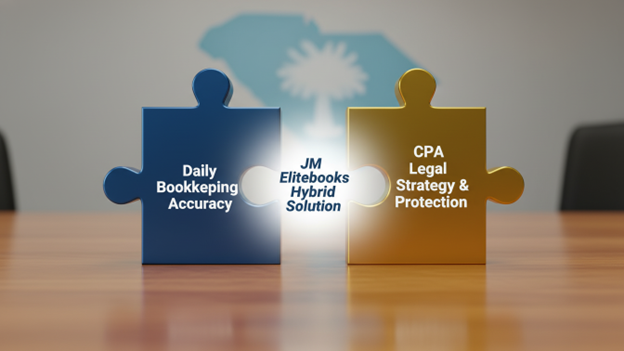
The JM Elitebooks Hybrid Model (What 90% of SC Businesses Actually Need)
We give you:
- Full-time professional bookkeeping (daily accuracy, payroll, reconciliations).
- CPA oversight & review (tax planning, audit protection when needed).
- Enrolled Agent on staff for IRS representation.
- Year-round tax strategy calls.
Result: You get everything a $400/hr CPA provides for the 5% of work that actually requires one but pay bookkeeper prices for the 95% routine work.
Average client saves $9,000–$18,000 per year vs. traditional CPA firms with zero compromise.
Bottom Line – Be Honest With Yourself
If your CPA is doing your monthly reconciliations → fire them for that work.
If your bookkeeper is giving you high-level tax strategy → they’re overstepping (and risking your liability).
Get both. Pay the right price for each.

Want to see exactly how much you're overpaying right now?
Book a free 15-minute “CPA vs Bookkeeper Audit” — we’ll review your current setup and show you the numbers.
No sales pitch. Just facts.
Most people who take this call save $800+/month starting next month. When was the last time your CPA did that for you?