
Estate planning and taxes often create confusion especially when trusts are involved. One of the most common questions people ask is:
Does a revocable trust have a tax ID number?
The answer is simpler than most people think but getting it wrong can cause IRS filing errors, bank delays, and compliance problems.
This guide explains exactly how revocable trusts are treated by the IRS, when a tax ID number is required, and how this works in real-life situations.
Short Answer: Does a Revocable Trust Have a Tax ID Number?
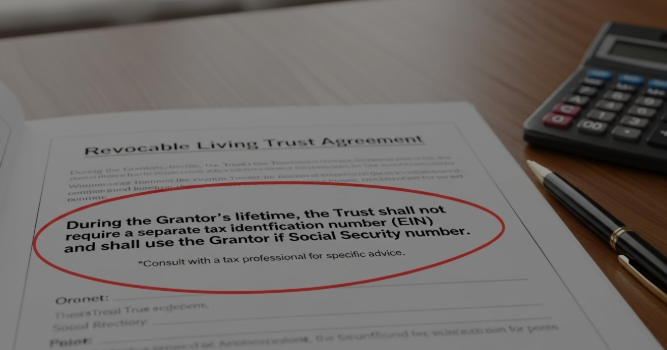
No, a revocable trust does NOT need its own tax ID number (EIN) while the grantor is alive.
Instead, the trust uses the grantor’s Social Security Number (SSN) for all tax reporting purposes.
However, once the grantor dies, the trust usually must obtain its own EIN because it becomes a separate taxable entity.
Understanding Whether a Revocable Trust Has a Tax ID Number
What Is a Revocable Trust?
A revocable trust (also called a living trust) is a legal arrangement where:
- The creator (grantor) keeps full control
- Assets can be added, removed, or changed
- The trust can be revoked at any time
From a tax standpoint, the key point is this:
The grantor and the trust are treated as the same person by the IRS.
How the IRS Views a Revocable Trust
The IRS classifies revocable trusts as grantor trusts.
That means:
- The trust itself does not pay taxes
- All income flows directly to the grantor
- The grantor reports income on their personal tax return (Form 1040)
Because the trust is not a separate taxpayer, no separate tax ID number is required during the grantor’s lifetime.
Does a Revocable Trust Have a Tax ID Number During the Grantor’s Lifetime?
No.
During the grantor’s lifetime:
- The trust uses the grantor’s SSN
- No Form 1041 is filed
- No EIN is required
This applies even if the trust owns:
- Bank accounts
- Investment accounts
- Rental property
- Business interests (in many cases)
When a Revocable Trust DOES Need a Tax ID Number
After the Grantor Dies
Once the grantor passes away:
- The trust becomes irrevocable
- It is now a separate legal and tax entity
- The IRS requires an EIN
At this point:
- Income is reported on Form 1041
- Beneficiaries may receive Schedule K-1
- The trust must file its own tax return
When the Trust Has Income Without the Grantor
If income is earned after death, such as:
- Rental income
- Dividends
- Interest
- Capital gains
An EIN is mandatory.
When Banks or Institutions Require an EIN
Even during life, some institutions may request an EIN for administrative reasons. While not legally required, many trustees choose to obtain one after death to simplify account management.
Real-Life Examples
Example 1: Revocable Trust While Owner Is Alive
John creates a revocable living trust and places his home and brokerage account into it.
- John is alive
- The trust earns dividends
- John reports everything on Form 1040 using his SSN
No EIN required
Example 2: Revocable Trust After Death
After John passes away:
- The trust holds investments earning income
- Beneficiaries have not yet received distributions
The trustee must:
- Apply for an EIN
- File Form 1041
- Issue Schedule K-1s if needed
Example 3: Rental Property in a Revocable Trust
Sarah places her rental property into a revocable trust.
- While alive: rental income goes on Schedule E using her SSN
- After death: trust needs EIN and files Form 1041
This is a very common IRS mistake area.
How to Handle Tax ID Numbers for a Revocable Trust
Confirm Whether the Grantor Is Alive
Alive = SSN
Deceased = EIN required
Identify Income Sources
Rental, dividends, interest, capital gains
Determine IRS Filing Status
Form 1040 vs Form 1041
Apply for EIN If Needed
Online via IRS EIN application (free)
File Correct Returns
Avoid penalties and delayed distributions
Revocable Trust vs Irrevocable Trust Tax ID Rules
| Trust Type | Tax ID Used | Who Pays Tax | IRS Filing |
|---|---|---|---|
| Revocable (Grantor Alive) | Grantor SSN | Grantor | Form 1040 |
| Revocable (After Death) | EIN | Trust | Form 1041 |
| Irrevocable Trust | EIN | Trust/Beneficiaries | Form 1041 |
| Testamentary Trust | EIN | Trust | Form 1041 |
FAQs About Does a Revocable Trust Have a Tax ID Number
Does a revocable trust have a tax ID number while the grantor is alive?
No. It uses the grantor’s SSN.
When does a revocable trust need an EIN?
After the grantor’s death or when it becomes irrevocable.
Can I get an EIN for a revocable trust anyway?
You can, but it’s usually unnecessary until death.
Do banks require an EIN for revocable trusts?
Some do after death, not typically during life.
Does a revocable trust file a tax return?
Not during the grantor’s lifetime.
What happens if I use the wrong tax ID?
It can trigger IRS notices and compliance issues.
Does rental income change EIN rules?
Only after the grantor dies.
Should trustees consult a tax professional?
Yes especially during trust administration.
Conclusion
So, does a revocable trust have a tax ID number? For more information and detailed guide regarding all the taxes visit JM ELITE BOOKS now!
✔ During the grantor’s lifetime: No it uses the grantor’s SSN
✔ After death: Yes an EIN is required
✔ IRS treatment: Grantor trust until it becomes irrevocable
Understanding this distinction prevents IRS penalties, filing errors, and estate delays.